Rabu, 14 November 2018

The Devil's Dinner: How Chili Peppers Took Over the World

The taste for hot and spicy food has become an international passion in modern times. Many world cuisines rely on forthright, edgy seasoning for their appeal, particularly outside their regions of origin. But what they all have in common is one of the most widely traveled spices in global food history—the chili pepper. There is chili in the sizzling salsas of Mexican tradition, in the piri-piri marinades of Portugal, in the red-hot dishes of classical Indian cooking, in Thai curries, Sichuan specialties, punchy Korean relishes, and nourishing Vietnamese soups. And of course, in the celebrated state dish of Texas. In tamer guise, it found its way into Hungarian goulash and the 'deviled' preparations of central European cookery.

There are sound reasons for chili's global reach. It's pretty good for you, to begin with, a highly nutritious fruit with vitamins and minerals in abundance, its molten-lava heat an effective remedy for warming you up in cold conditions, and cooling you down when it gets too hot. It will grow in a wide variety of climates, and unlike other spices such as pepper, ginger, and cinnamon, it never became wildly expensive to consume. It was truly a democratic spice. And it adds vigor and excitement to the blandest food, enlivening rice and corn dishes into something much more appealing to the jaded palate.

Something else, though, has happened to chili in the modern world. As well as being an indispensable seasoning and flavoring ingredient, it has found itself the center of a devotional cult across the western hemisphere. A kind of arms race has sprung up among pepper growers, with dedicated cultivators constantly seeking to outdo each other in producing hotter and hotter varieties of chili. Keeping up with who currently lays claim to the most incendiary pepper in the world is almost as frantic as following trading on the global stock exchanges. And along with that agricultural competition has come a consumer willingness to engage in chili consumption as a spectator sport. YouTube is full of video clips of people trying—really trying—to cope with the onslaught of consuming chilies that are literally hundreds of thousands of times hotter than famous hot sauce products like Tabasco.

In my book, The Devil's Dinner, I take a look at all these tendencies, following the migratory history of the chili pepper as it set off around the known world from its origins in Central and South America with the voyages of discovery and the trading missions of the 1500s. We find out what culinary uses chili has been put to in all of the various regions in which it has found a home. I offer a selective listing of chili varieties and their properties, including some of the unlikeliest specimens of...

Keep reading on Quick and Dirty Tips

A 6-Step Guide to Managing Your Student Loans

I know many of you are suffocating under a mountain of student loan debt. Approximately 43 million borrowers, or seven in 10 U.S. graduates, are carrying over $1.25 trillion in student loans. The average debt is at an all-time high, $37,000 per graduate.

No matter if you can afford your student loan payments or are struggling to make them, it’s important to know your options. Many graduates have multiple loans from a variety of lenders. So, get familiar with what you owe and who you owe it to. If you’re not sure, visit your lenders’ websites or review free copies of your credit reports at CreditKarma.com or AnnualCreditReport.com. Having all your loan accounts and their interest rates and terms listed in one place allows you to see the big picture of your finances and know what to prioritize.

If you have more than one federal student loan, the government can consolidate or combine them into one loan with an interest rate that’s a weighted average of all of your rates. A consolidation doesn’t reduce the interest rate, but it does give you these benefits:

  • Fewer accounts and payments to keep track of each month 
  • Any older, variable-rate loans are converted into one fixed-rate loan (since 2006 they are all fixed) 
  • No or minimal fees 
  • Lower monthly payments, if the length of your payment term is extended

Both students and parents can consolidate education loans; however, you can’t combine loans that are in different names. Only loans from the same borrower can be consolidated—even married couples must keep their respective education loans separate. There are usually minimal fees to do a student loan consolidation, and you can work with any lender you choose.

The major downside to consolidating federal student loans is that you may lose special features or benefits that come with your original loans, such as forgiveness for public service work, forbearance for financial hardship, repayment options, and certain interest rate discounts and rebates. So, always ask potential lenders what loan options you’d give up in a consolidation.

Use the Loan Consolidation Calculator at FinAid.org to compare the monthly savings to the increase in total interest expense over the life of the loan. Carefully analyze the cost of repaying your original loans against the cost of paying for a consolidated loan.

Now, let’s talk about private...

Keep reading on Quick and Dirty Tips

Selasa, 13 November 2018

What's It Like to Work on a Cattle Ranch?

Welcome to the second installment in our Faces of Farming series, an idea that grew out of the desire that many of us have to know more about where our food comes from. Few of us have the opportunity to visit a working ranch, farm, or field and see for ourselves what goes on there on a day-to-day basis. What does it take to get our food from the field to our table, and who are the people that are doing this vital work?

Each week, I'm talking to someone from a different part of the agricultural community about what drives them, their hopes and fears for the future of farming, how their industry is working to improve conditions for animals and workers, protect the environment, increase sustainability, and so on.

Last week, we talked to vegetable grower Dale Huss, who manages hundreds of fields for Ocean Mist, a company that grows over a dozen types of conventional and organic vegetables and delivers millions of pounds of fresh produce to grocery stores all over the country each week.

This week, we’re talking to Dr. Tera Barnhardt, Doctor of Veterinary Medicine, proud daughter of the sunflower state (Kansas), and coordinator of animal health and welfare for a company called Cattle Empire in Kansas

I’ve talked in past podcasts about the various issues and concerns related to beef and red meat, in general. There have been some high-profile studies over the years linking red meat to increased risk of disease. This has led many to consider eliminating red meat from their diet.

However, as I have pointed out, the health risks associated with red meat consumption are only seen in those eating two or three servings of red meat per day. Those who are only eating two or three servings per week, on the other hand, tend to have the same risks as those who never eat red meat. Meanwhile, lean beef is a superior source of certain nutrients including protein, iron and B12.

Other studies have demonstrated that when red meat is consumed in the context of a healthy diet, it can actually improve heart health.  When you consider that red meat is often higher in heart-healthy monounsaturated fats than chicken or turkey, that doesn’t seem surprising.

But health and nutrition are not the only concerns. Some people choose not to consume meat for moral, ethical, or religious reasons. Others want to be assured that animals that we raise for food are treated humanely. Like you, I have heard some very disturbing stories about poor treatment of livestock. But I’ve also visited a fair number of feed yards and cattle ranches and I have to tell you that the reality that I have...

Keep reading on Quick and Dirty Tips

How to Balance Technology and Your Life

Technology has become a fixture in virtually every part of our life, every relationship, and every method of communication. As our smartphones have gotten, well, smarter, we use them for more and more. The next thing you know, that simple phone alarm clock woke you up...to a dozen notifications. By the time your feet hit the floor, you've already been sucked into the chaos of the day, conveniently delivered via notification, alert, email, text message, and a dozen social media services.
 
Today I speak with Dan Schawbel, author of the book Back to Human. Dan is a millenial who has devoted his career to understanding the challenges his generation faces at each step of their career. In Back to Human, he takes on the question of when we are best served with our tools and technology, and when we're best served by the human skills and abilities in our lives.
 
In the interview, which you can listen to in the audio player on this article, we discuss:
  • A dozen places technology serves us best, and how to improve your productivity using technology
  • How to create connection in an age of isolation
  • What an ideal schedule is to achieve work/life balance
  • Why Facebook friends aren't really friends...and how to know the difference
  • How having a happy, healthy, human workforce is good for business
  • How the illusion of connection disconnects us from real connection
  • The dark side of the freedom technology provides
Join me with Dan to learn more about why technology isn't the great savior many people believe it is. And why it isn't the evil monster that others shun. 
Keep reading on Quick and Dirty Tips

Why Do We Say 'Rubber Room'?

I wrote a novel I called “The Rubber Room” about two high school students who meet on in-school suspension.

My editor disliked the title.“I'd like to suggest that we consider a different title. I have a viscerally negative reaction to the term ‘the rubber room.'" The marketing and sales team said it conjured sex rooms and the mistreatment of the mentally ill. We retitled it "Wilder."

But sex rooms? I started asking people what “rubber room” meant, and found no consensus.

The Oxford English Dictionary yielded nothing. Of the six slang dictionaries I checked, only Green’s offered references:

Beckett, such a literary first citation and, it turns out, a prescient one. But could 1938 really be the earliest usage?

I dug in.

And now, I present a brief family tree of “rubber room,” with four branches, a disco, and three bogus etymologies.

Branch One: The Asylum

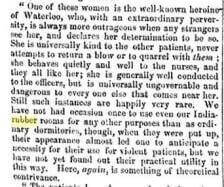
“We have not had occasion once to use even our India-rubber rooms for any other purposes than as ordinary dormitories...”

Suffolk Lunatic Asylum, Annual Report of Medical Officer, 1845.

The earliest reference I could find, this report conveys its brutal assumptions about mental illness—and language’s role in those assumptions—in its first sentence: “There are, in the county, perhaps about three hundred and sixty insane paupers, i.e. lunatics and idiots.” But the report also argues against the use of restraints and coercion with this strikingly progressive adage: “You may do almost everything by soothing and kindness, you can rarely do almost anything but mischief by force.” This, coincidentally, could serve as my narrator’s epitaph.


As with other sensationalized and...

Keep reading on Quick and Dirty Tips

5 Ways to Protect Your Eating Instincts

Food is supposed to sustain and nourish us. Eating well, any doctor will tell you, is the best way to take care of yourself. Feeding well, any human will tell you, is the most important job a mother has. But for too many of us, food now feels dangerous. We categorize food as “good” and “bad” (and the bad list is always longer). We think we have to “earn” dessert and should apologize for wanting a cookie, or even just feeling hungry for lunch. Studies show that half of preschool-age girls worry about being fat; 40 percent of teenage girls use restrictive measures to lose weight and 60 percent of American adults are on a diet—even though many of them have tried and failed to lose weight through restriction as many as twenty previous times.

We’re mixed up about food because we live in a culture that tells us we can’t trust our bodies. But this isn’t true—everyone is born with three key eating instincts. Think about how newborn babies eat. They know when they’re hungry; that’s why they cry! And they know when they’re full—they simply stop nursing or bottle-feeding and fall asleep when they’re warm, cozy, and fed. And, they know that food must provide comfort as well as physical nourishment. Eating is how babies form secure attachments to their caregivers; it’s how they fall in love.

As babies grow into children, they naturally disconnect a bit from their eating instincts, because they learn to eat at mealtimes and according to the customs of their family. But too often, we’re told to ignore our eating instincts for far more arbitrary reasons—because a new diet trend says so, or because a parent thinks we have to clean our plate. Many of us feel guilty if we find comfort in food, forgetting how essential that is to the eating process. And many of us ignore our hunger or our fullness cues; restricting till we can ignore our hunger or overeating past the point of physical comfort. Lots of us do both.

For my book, The Eating Instinct, I interviewed dozens of people about their relationships with food. And it didn’t matter if they were recovering from orthorexia and obsessed with clean eating, or recovering from weight loss surgery and trying to figure out how to eat with a newly shrunken stomach, or living in poverty and worrying about having enough to eat, period. Folks with all kinds of eating struggles, in all walks of life asked the same questions: How did we learn to eat this way? Why is it so hard to feel good about food? And how can we make it better?

The answer is to reconnect with your eating instincts and trust yourself first, around food. Not some wellness guru. Not some new diet plan. Just...

Keep reading on Quick and Dirty Tips

The Program: Christine S. O'Brien on Growing Up Hungry

In "Crave," Christine S. O'Brien tells the story of a childhood full of hunger, both for food and family stability. Her father was an explosively angry and highly successful ABC executive, and despite their luxurious New York life, her mom insisted her family follow a strict diet called "The Program," consisting mostly of celery juice and blended salads. "Crave" tells the story of Christine's journey of mental and physical hunger, and ultimately, her awakening.  

***

I am ten and standing in the doorway of my parents’ bedroom. My mother is lying in her evening clothes, a cream pantsuit and heels, her towering five-foot-eight frame prone like a felled tree on the hardwood floor of the hallway. It’s almost midnight. My father is crouched beside her, one hand on his bent thigh. Murtle, our latest live-in, is crouching, then standing, then crouching again. She is in her uniform, though it is half zipped, revealing the upper part of her bare back, and she is barefoot and not wearing stockings.

“Go back to bed, Christine,” my father says, barely glancing at me.

Murtle takes my arm and gently guides me away from my parents’ room, where I had been asleep in their bed, waiting for their return from a dinner party. She leads me through the door of my brothers’ rooms and into the playroom.

“The ambulance weel be coming,” Murtle says. Her voice is lilting and soft, though the pressure of her squeeze on my arm is firm. “Your mother weel be fine.”

From the playroom I peer through the crack in the door and into the dim hallway. Murtle and my father stand as men in jumpsuits lift my mother onto a gurney, then follow the men as they push it, its wheels rolling loudly on the bare wood, away down the hall.

* * *

It’s springtime and my mother, nine, walks through her father’s orchards with Topsy, her family’s Saint Bernard. Topsy touches the back of my mother’s leg with her cold nose. When her father brought the puppy home, she was tiny with oversize paws. Now, at three, she is big enough for my mother to ride. Though the farm is filled with dogs, her mother always keeps a small dog—there have been multiple Tippys, Jippys, Trixies, Skippys, Spottys, Fidos, and two Lassies, but Topsy is my mother’s favorite. The dog never leaves my mother’s side, even standing guard across her body as she plays in the sandbox.

My mother reaches out to pet Topsy with her left arm, crooked at the elbow, the result of a fall from a stepladder when she was fourteen months old. The doctor, who had been retrieved from a Sunday night church meeting, didn’t set the bone correctly. He also...

Keep reading on Quick and Dirty Tips